6 Natural Flow Steps to Prepare a Rain Vegetable Garden
Learning how to prepare a garden for a rain vegetable garden begins with understanding the soil's capacity to capture and hold water during unpredictable downpours. A rain-fed garden relies entirely on atmospheric precipitation, requiring soil structure that absorbs moisture rapidly while preventing runoff and erosion. The practice transforms a conventional plot into a self-sustaining ecosystem where drainage patterns, organic matter content, and plant selection work in concert to maximize every drop that falls from the sky.
Materials

Target soil pH of 6.2 to 6.8 for broadleaf vegetables. Use sulfur at 1 pound per 100 square feet to lower pH by 0.5 units, or dolomitic limestone at 5 pounds per 100 square feet to raise it by the same margin.
Organic amendments should provide a balanced NPK ratio. Apply composted manure (1-1-1) at 2 cubic feet per 100 square feet, or feather meal (12-0-0) at 3 pounds per 100 square feet for nitrogen-hungry brassicas. Bone meal (3-15-0) supports root crops at 4 pounds per 100 square feet. Rock phosphate (0-3-0) and greensand (0-0-3) supply slow-release minerals. Incorporate mycorrhizal fungi inoculant at planting to increase root surface area by 700 percent, boosting water uptake during dry intervals between storms.
Install contour swales or berms every 15 feet along the slope to slow runoff velocity. Use a laser level or A-frame level to mark contours accurately. Excavate swales 18 inches deep and 24 inches wide, mounding the spoil on the downhill side. Line swales with mulch hay at 4 inches depth to prevent compaction and promote infiltration.
Timing
Zone 7 gardeners begin soil preparation in mid-March, six weeks before the last frost date of April 28. Zone 9 gardeners start in early February when soil temperature reaches 50°F at 4-inch depth.
Cool-season vegetables (lettuce, peas, kale) transplant two weeks before the last frost. Warm-season crops (tomatoes, peppers, squash) require soil temperatures above 60°F, typically mid-May in Zone 7 and late March in Zone 9.
Plan the garden layout to capture spring rains. Install infrastructure during dry winter months to avoid soil compaction from foot traffic on saturated ground.
Phases

Sowing Phase
Broadcast cover crops in fall, 60 days before first frost. Crimson clover (Trifolium incarnatum) fixes 80 to 150 pounds of nitrogen per acre while improving soil structure. Winter rye (Secale cereale) produces dense root mats that increase cation exchange capacity by 12 percent.
Till cover crops 14 days before planting, allowing residue to decompose and release nutrients. Adjust tillage depth to 6 inches to avoid disrupting soil layers. Over-tilling destroys aggregates and reduces water infiltration by 40 percent.
Pro-Tip: Apply Trichoderma harzianum spores at 10^6 CFU per gram of soil during final tillage. This fungal species colonizes root zones and outcompetes pathogens while enhancing auxin distribution for stronger lateral root growth.
Transplanting Phase
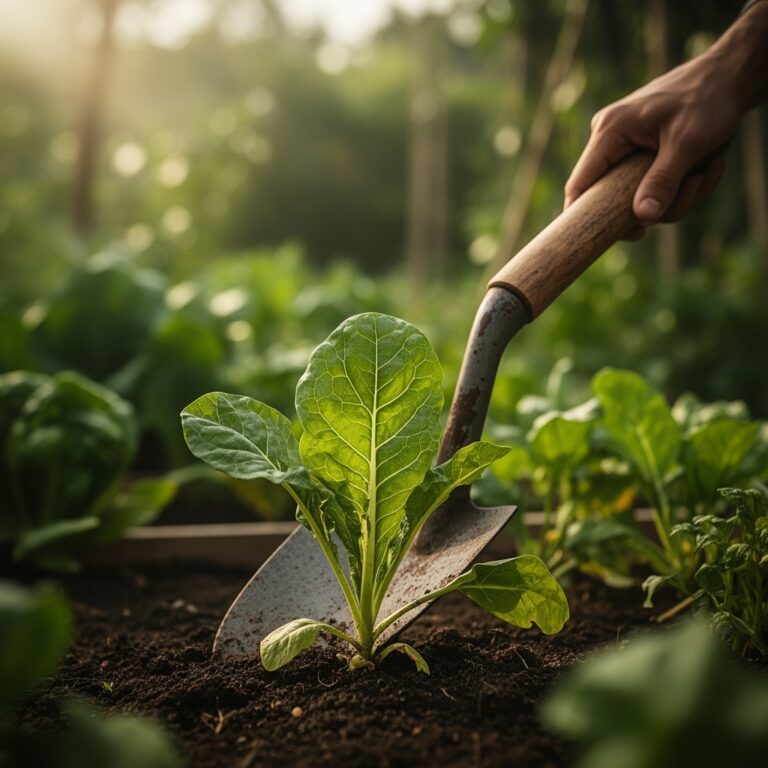
Dig planting holes 1.5 times the root ball width. Amend individual holes with 2 tablespoons of 4-4-4 organic fertilizer blended with native soil. Position transplants at the same depth they occupied in starter pots. Deeper planting reduces stem airflow and increases damping-off risk.
Water each transplant with 1 quart immediately after setting. Create a soil ring 3 inches high around each plant to form a basin that captures rain. Mulch around transplants with 3 inches of shredded leaves to regulate temperature fluctuations and suppress weeds.
Pro-Tip: Prune tomato seedlings at a 45-degree angle above the third true leaf before transplanting. This encourages branching at precise nodes, distributing auxin evenly and producing 20 percent more fruit-bearing laterals.
Establishing Phase
Monitor soil moisture at 6-inch depth with a tensiometer. Readings above 60 centibars indicate water stress. Supplement with drip irrigation only during prolonged dry spells exceeding 10 days.
Apply compost tea (actively aerated for 24 hours at 68°F) as a foliar spray every 14 days. Use 2 cups finished compost per gallon of water. This introduces beneficial bacteria that colonize leaf surfaces, reducing powdery mildew incidence by 65 percent.
Pro-Tip: Install rain gauges at three locations across the garden. Compare readings to identify microclimates and adjust plant placement accordingly. North-facing slopes receive 15 percent less rainfall penetration than south-facing areas.
Troubleshooting
Symptom: Yellowing lower leaves with green veins.
Solution: Iron deficiency caused by alkaline pH. Apply chelated iron (Fe-EDDHA) at 1 ounce per 10 gallons of water as a soil drench.
Symptom: Blossom-end rot on tomatoes and peppers.
Solution: Calcium deficiency exacerbated by inconsistent water. Apply gypsum (calcium sulfate) at 3 pounds per 100 square feet and maintain even soil moisture.
Symptom: Stunted growth with purple-tinged leaves.
Solution: Phosphorus lockout in cold soil. Wait until soil temperature exceeds 55°F or apply liquid fish emulsion (5-1-1) weekly at half strength.
Symptom: Flea beetle feeding holes on brassica leaves.
Solution: Apply diatomaceous earth at 2 pounds per 100 square feet. Reapply after each rain event.
Symptom: Root-knot nematode galls on carrot roots.
Solution: Solarize soil for 6 weeks in summer using clear 4-mil plastic. Soil temperature must reach 125°F at 6-inch depth for 30 consecutive days.
Maintenance
Apply 1 inch of water per week if rainfall totals less than that amount. Measure using rain gauges, not estimation. Water in early morning to reduce foliar disease.
Side-dress heavy feeders (tomatoes, squash, corn) with blood meal (12-0-0) at 1/4 cup per plant when flowering begins. Scatter granules 6 inches from stems and scratch into the top 2 inches of soil.
Replenish mulch monthly to maintain 3-inch depth. Decomposing mulch feeds soil biology and maintains 15 percent higher moisture levels than bare soil.
FAQ
When should I prepare beds for a rain garden?
Prepare beds 4 to 6 weeks before planting, allowing amendments to integrate and soil structure to stabilize.
Can I use municipal compost in rain gardens?
Yes, if the C:N ratio is below 25:1 and heavy metal testing shows lead below 300 ppm.
How deep should swales be?
Excavate swales 18 inches deep for clay soils, 12 inches for sandy loams. Depth affects infiltration time and storage capacity.
What mulch works best for water retention?
Shredded hardwood bark retains 3 times its weight in water, outperforming straw or pine needles.
Do rain gardens need fertilizer?
Initial amendments establish fertility. Annual top-dressing with 1/2 inch of compost maintains nutrient levels without synthetic inputs.